

Introduction
Global maritime traffic is growing steadily, driven by increasing demands for navigational safety, efficient port operations, and the protection of the marine environment. In this context, Vessel Traffic Services (VTS) have become indispensable strategic infrastructure for maritime authorities, commercial ports, and sensitive coastal areas around the world.
Successfully delivering a VTS project, however, goes far beyond installing radars, AIS antennas, or cameras. It requires designing a comprehensive system compliant with the international standards set by the International Maritime Organization (IMO) and the best practices of the International Association of Marine Aids to Navigation and Lighthouse Authorities (IALA).
Whether the goal is to establish a new VTS centre, modernise an existing infrastructure, or achieve compliance ahead of an IMSAS audit, project success depends on a solid methodology covering all dimensions: the international regulatory framework (SOLAS, Resolution A.1158(32)), technical infrastructure design and surveillance systems, IALA-standard personnel training and certification, and close coordination with all national and international stakeholders.
“Vessel traffic services make a valuable contribution to safety of navigation, improved efficiency of traffic flow and the protection of the marine environment.”
— IMO, Resolution A.1158(32), 2021
This article guides you through the key steps, covering the strategic, regulatory, technical, human and forward-looking dimensions of a high-performing, sustainable VTS project — in full compliance with IMO and IALA standards.
1. Understanding the Purpose and Regulatory Framework of VTS
1.1 The Core Mission of a VTS System
According to IMO recommendations, the primary mission of a VTS is to support human decision-making — not to replace it. A well-designed project must simultaneously integrate the operational, technological, regulatory and human dimensions.
The operational objectives of a compliant VTS are:
- Improving navigational safety and preventing collisions, groundings and allisions
- Smoothing and organising maritime traffic flow in high-density or high-risk areas
- Protecting human life at sea and coordinating with SAR services
- Preventing marine pollution and protecting ecologically sensitive areas
- Ensuring the security of port installations and managing safety incidents
1.2 The International Regulatory Framework
Every VTS project must align with the following regulatory instruments:
| Instrument | Body | Scope |
|---|---|---|
| SOLAS, Chapter V, Regulation 12 | IMO | Right of States to establish VTS — mandatory participation within territorial waters |
| Resolution A.1158(32) (2021) | IMO | Revised VTS Guidelines — primary post-2021 reference |
| VTS Manual, Ed. 8.3 (2024) | IALA | Operational guide: establishment, operations, training, audit |
| Recommendation R0127 (V-127) | IALA | VTS Operations — harmonised procedures |
| Recommendation R0119 | IALA | Establishment of a VTS |
| Guideline G1141 | IALA | Operational procedures for delivering VTS services |
| GMDSS / VHF Standards | ITU | Maritime radio standards and emergency communications |
| OT/IT Cybersecurity Standards | IMO MSC-FAL.1/Circ.3 | Maritime cyber risk management |
1.3 The Three IMO-Recognised VTS Services
The IMO distinguishes three fundamental service types that every compliant VTS must be able to provide:
- Information Service (IS): dissemination of information on traffic, weather and navigational hazards
- Navigational Assistance Service (NAS): active navigational assistance on request or at the VTS operator’s initiative
- Traffic Organisation Service (TOS): active regulation and organisation of traffic flow within the VTS area
Each service must be justified by a formal risk assessment. Resolution A.1158(32) also establishes a three-tier responsibility framework: governmental, competent authority, and VTS provider.
2. Conducting a Rigorous Risk Assessment
The IMO is unequivocal: the need for a VTS must be evaluated and justified through a formal Risk Assessment Study. Without this step, the project risks becoming a simple equipment purchase with no operational coherence. This study determines the system’s scope, service level and regulatory legitimacy.
The assessment must comprehensively analyse:
- Traffic density and vessel types: commercial shipping, fishing, passenger vessels, tankers, bulk carriers
- Geographical characteristics: narrow channels, shoals, crossing zones, port approaches
- Transport of dangerous or polluting cargo (MARPOL)
- Historical data on incidents, accidents, near-misses and groundings
- Recurrent weather conditions: fog, strong winds, swell, reduced visibility
- Ecologically sensitive areas (PSSA — Particularly Sensitive Sea Areas)
- Security threats, piracy, intrusions into port areas
Best practice: involve port authorities, maritime pilots, harbour masters, shipowners and coast guards from this stage onwards. Their operational expertise is irreplaceable for correctly calibrating the service level and defining the VTS area boundaries.
The geographical boundaries of the VTS area must then be formalised, published in Notices to Mariners and incorporated into official nautical charts. Area boundaries must never be located at vessels’ habitual course-alteration points.
3. Designing a Resilient and Scalable Technical Architecture
3.1 Sensor Infrastructure
The technological core of a VTS rests on an integrated multi-sensor architecture designed to operate continuously 24/7, with redundancy of critical systems and no single point of failure.
| Equipment | Role | Key Requirement |
|---|---|---|
| Long-range maritime radar | Real-time surface surveillance | Redundancy, periodic recalibration |
| AIS (Automatic Identification System) | Vessel identification and tracking | SOLAS V/19 compliance, IMO A.917(22) |
| EO/IR day/night cameras | Visual surveillance of the area | Coverage of radar blind spots |
| Weather stations / tide gauges | Real-time hydro-meteorological data | Centralised time synchronisation |
| Marine VHF radio / DSC | Vessel-to-VTS communications | IMO SMCP standard, mandatory recording |
| Future sensors (drones, satellites, sonar) | Coverage extension | Integration into open architecture |
3.2 Communication Backbone
The reliability of the transmission network is as critical as the sensors themselves:
- Fibre optic as primary infrastructure
- Microwave links as redundancy
- Secure 4G/5G for remote sites
- Backup satellite link for continuity in case of disaster
- Centralised time synchronisation (GPS/NTP) for data correlation
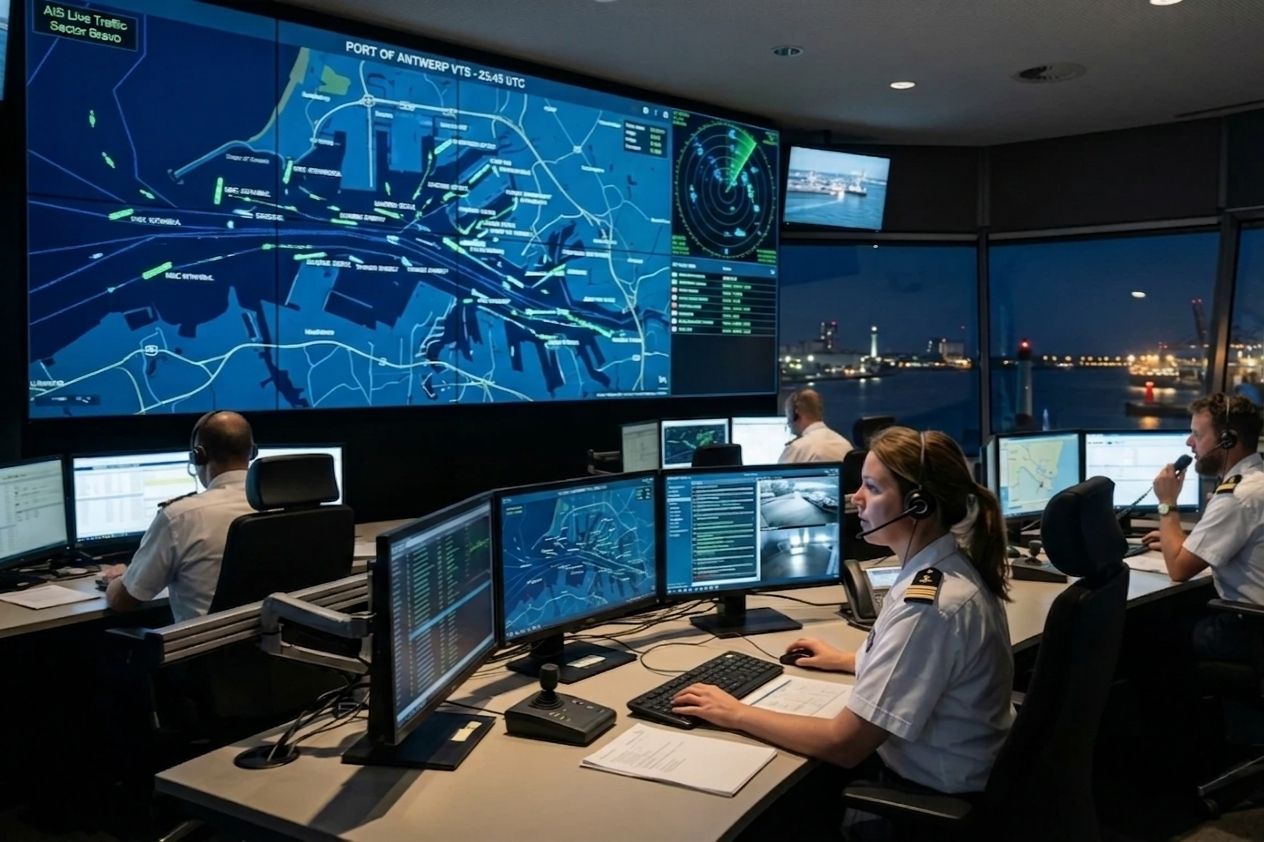
3.3 VTS Control Centre
The control centre is the operational brain of the system. It must include:
- Ergonomic operator consoles designed for extended watch periods
- High-resolution video walls for global supervision
- Redundant servers and backed-up power supply
- Secondary centre (backup site) for disaster recovery
- Complete recording and full traceability of all communications and data
Design principle: a good VTS project must be able to evolve over 10 to 15 years without a complete overhaul. An open and modular architecture is a decisive selection criterion when drafting the technical specifications.
3.4 Human-Machine Interface (HMI)
Many projects fail not because of the technology, but because of a poor operator experience. A high-performance VTS software solution must provide:
- Intuitive chart display with Radar + AIS + Camera + AtoN overlay
- Configurable CPA/TCPA alerts (risk of collision and close-quarters situations)
- Historical replay for post-incident analysis
- Documented incident management and event log
- Multi-criteria search and data export for audits
The operator must be able to make a critical decision within seconds. Ergonomics is not a luxury.
4. Integrating Cybersecurity from the Outset
A VTS is today a critical digital infrastructure exposed to cyber threats. IMO circular MSC-FAL.1/Circ.3 mandates formalised maritime cyber risk management. Cybersecurity must never be added after installation — it must be architectural.
Essential measures to integrate from the design phase:
- Strict segmentation of IT (management) and OT (industrial control systems) networks
- Industrial firewalls and intrusion detection systems (IDS/IPS)
- Strong access control: multi-factor authentication, clearance management
- Full logging and monitoring by a SOC (Security Operations Center)
- Encrypted backups with a tested business continuity plan
- Vulnerability management and secure software update policy
- Documented and regularly exercised cyber crisis management procedures
5. Training, Certifying and Professionalising Teams
“A major factor in the operation of VTS is the competence of their personnel.”
— IMO, Resolution A.1158(32)
A technically flawless VTS system can fail for lack of trained operators. IALA has developed a structured qualification framework organised into three progressive levels:
| Level | Primary Responsibilities |
|---|---|
| VTS Operator | Traffic surveillance, vessel-to-shore communications, radio watch, data entry |
| VTS Supervisor | Operator supervision, incident management, liaison with authorities |
| VTS Manager | Centre management, personnel management, institutional relations, audits |
Each level requires an approved training programme including:
- Theoretical training on COLREG, SOLAS, MARPOL regulations and IMO procedures
- Practical training on an IALA-approved VTS simulator
- Placement at an operational VTS centre
- Certification by examination validated by the national competent authority
- Annual refresher training and regular simulation exercises
- Ongoing technical training for maintenance personnel
6. Documenting Operational Procedures (IOP)
Internal Operating Procedures (IOP) form the documentary backbone of a VTS. They must cover all situations — routine and emergency — and be regularly updated following every exercise, incident or regulatory change.
Essential procedures to document include:
- Vessel entry and exit reporting within the VTS area
- Standard and emergency communications in accordance with the IMO SMCP
- Incident management: collision, grounding, sinking, man overboard, fire on board
- Marine pollution response and place of refuge activation (IMO A.949(23))
- Medical emergencies on board and SAR coordination
- Meteorological procedures and area closure in extreme conditions
- Natural disasters: earthquakes, tsunamis, major weather events
- System failure and operational continuity (Contingency Plan)
7. Establishing Professional and Sustainable Maintenance
After commissioning, the real project begins. A VTS without a solid maintenance contract deteriorates rapidly in terms of availability and compliance. The maintenance contract must cover:
- 24/7 technical support with guaranteed SLAs and defined recovery times
- Planned preventive maintenance: radar, AIS, cameras, network, power supply
- Critical spare parts stocked on-site or at a regional depot
- Regular software updates and security patch management
- Radar recalibration and periodic performance verification of sensors
- Continuous cyber monitoring and security log review
- Annual performance and IALA compliance audits
8. Managing the Project with Rigorous Governance
A VTS project mobilises many stakeholders with distinct interests and expertise. Structured governance is essential to maintain project coherence, meet deadlines and achieve compliance objectives.
8.1 Stakeholders to Involve
- National maritime authority and ministry of transport
- Port authority and lighthouse/buoy administration
- Navy / Coast Guard
- Maritime pilotage services
- Telecommunications operators and network infrastructure
- National hydrographic service
- Civil protection and emergency services
8.2 Recommended Project Governance Framework
- Strategic steering committee with representation from all stakeholders
- Dedicated PMO (Project Management Office) with a project manager experienced in maritime systems
- Project risk register and formalised mitigation plan
- Master schedule with clearly defined contractual milestones
- Deliverable validation procedures: FAT (Factory Acceptance Test), SAT (Site Acceptance Test), Sea Acceptance Test
- Weekly project dashboard and monthly reporting to the steering committee
9. Audit, Compliance and Continuous Improvement
9.1 The IMSAS Audit and IALA Assessment
The IMO Member State Audit Scheme (IMSAS) periodically assesses the implementation of international maritime instruments, including VTS provisions. In addition, IALA offers its own audit framework (Recommendation R1013) for self-assessment and third-party evaluation of VTS centres. These audits cover the legal framework, technical infrastructure, personnel qualifications, documented procedures and contingency plans.
9.2 A Culture of Continuous Improvement
A compliant VTS cannot rest on static compliance. Continuous improvement is reflected in:
- Systematic analysis of incidents and near-misses
- Regular simulation exercises including complex emergency scenarios
- IMO/IALA regulatory monitoring and updating of procedures accordingly
- VTS performance indicators (KPIs): response time, system availability, incident rate
- Gathering and integrating feedback from staff and VTS users
10. 2026 Vision: From VTS to Smart Maritime Domain
Next-generation VTS projects now go far beyond traditional traffic control, evolving towards genuine maritime intelligence centres. Emerging technologies are profoundly transforming operational capabilities:
- Artificial Intelligence behavioural detection of vessels, traffic anomaly identification, collision prediction
- Multi-sensor fusion automatic correlation of Radar / AIS / Camera / AtoN for a unified maritime picture
- Coastal drones surveillance of areas not covered by fixed sensors, rapid response
- Port digital twins real-time simulation and optimisation of traffic flows
- PCS Integration connection with Port Community Systems for end-to-end management
- Decision support dashboards real-time decision-making tools for port and maritime authorities
- Enhanced cybersecurity AI-driven detection of cyber threats on maritime OT networks
The next-generation VTS no longer simply monitors traffic. It becomes a Maritime Smart Control Center — a maritime intelligence hub capable of anticipating, deciding and protecting, in service of navigational safety, maritime sovereignty and sustainable development. In doing so, the VTS takes a decisive step forward: it becomes the operational foundation of Maritime Domain Awareness (MDA) — the sovereign, comprehensive understanding of everything occurring within a State’s maritime domain. MDA sets the strategic ambition; the Smart Maritime Domain provides the technological means to achieve and sustain it.
Conclusion
Successfully delivering a VTS project compliant with the International Maritime Organization requires far more than a hardware budget. It is a strategic transformation combining maritime safety, systems engineering, project governance, regulatory compliance, cybersecurity and operational excellence.
The highest-performing projects are those that engaged all stakeholders from the planning phase, grounded their approach in a rigorous risk assessment, and embraced international compliance not as an administrative constraint, but as a genuine lever for operational performance and credibility within the global maritime community.
An IMO-compliant VTS is a public service commitment to the safety of seafarers, the protection of the marine environment and the efficiency of international maritime trade. It is also the foundation of a Smart Maritime Control Center built for the future — and the cornerstone of Maritime Domain Awareness.
Regulatory and Documentary References
- IMO Resolution A.1158(32): Guidelines for Vessel Traffic Services (2021)
- IMO SOLAS Convention, Chapter V, Regulation 12: Vessel Traffic Services
- IMO Resolution A.949(23): Guidelines on Places of Refuge for Ships in Need of Assistance
- IMO MSC-FAL.1/Circ.3: Guidelines on Maritime Cyber Risk Management
- IALA VTS Manual, Edition 8.3 (March 2024)
- IALA Recommendation R0127 (V-127): VTS Operations
- IALA Recommendation R0119: Establishment of VTS
- IALA Guideline G1089: Provision of VTS Services
- IALA Guideline G1141: Operational Procedures for Delivering VTS
- IALA Recommendation R1013: Auditing and Assessing Vessel Traffic Services
- IMO Standard Marine Communication Phrases (SMCP)
- COLREG 1972 International Regulations for Preventing Collisions at Sea